
kobimusic/dettato
KobiMusic's multi-instrument audio-to-MIDI transcriber: notes, instrument tracks and drums from any recording
Thành tựu nổi bật
Những danh hiệu mới nhất của dự án
#1 Repository Của Ngày
#1 Repository Của Ngày
#1 Repository Của Ngày
dettato




KobiMusic's dettato is an audio to MIDI transcriber. You give it a recording and it writes a MIDI file, with one track for each instrument and a drum track. On nine public benchmark sets it beats MuScriptor 1.3B, which is the next best open model. It scores 59.2 composite F1 and MuScriptor scores 45.1. On the three sets that Mirelo publishes, it also scores a bit higher than Mirelo A2M v1.1 Pro, which is a closed model (60.8 to 56.1). The part I benchmarked is 20M parameters, and MuScriptor is about 65 times bigger.
dettato is four models in a chain. The transcriber (15.3M parameters) finds the notes. The evidence repairer (4.9M) fixes them using the transcriber's evidence. The grouper (2.9M) puts the notes into instrument tracks, and the drum model (5.0M) writes the drums. The code and the weights are under Apache-2.0, so commercial use is fine.
No copyrighted recordings. dettato was trained on a mix of synthetic instrument recordings and CC solo instruments from the URMP dataset. The rest of the instruments morph together around 20 soundfonts, using the soundfont babies technique I published. The vocals and the other augmentation are CC data too, and the grouper and drum model cards list the CC research datasets they use. No benchmark recording was used for training.
What to expect. It is hard to know how well it will work for your music from benchmarks alone, so I would try it first. The weakest step is putting the notes into the instrument tracks they belong in. For instance, on jazz recordings a quarter of the saxophone notes can land in the piano track. It also writes performance MIDI. This means the notes keep the timing of the recording, and they are not quantized to a beat. If you want something you can play from, like sheet music, I would recommend Songscription or Klangio. They are both great tools.
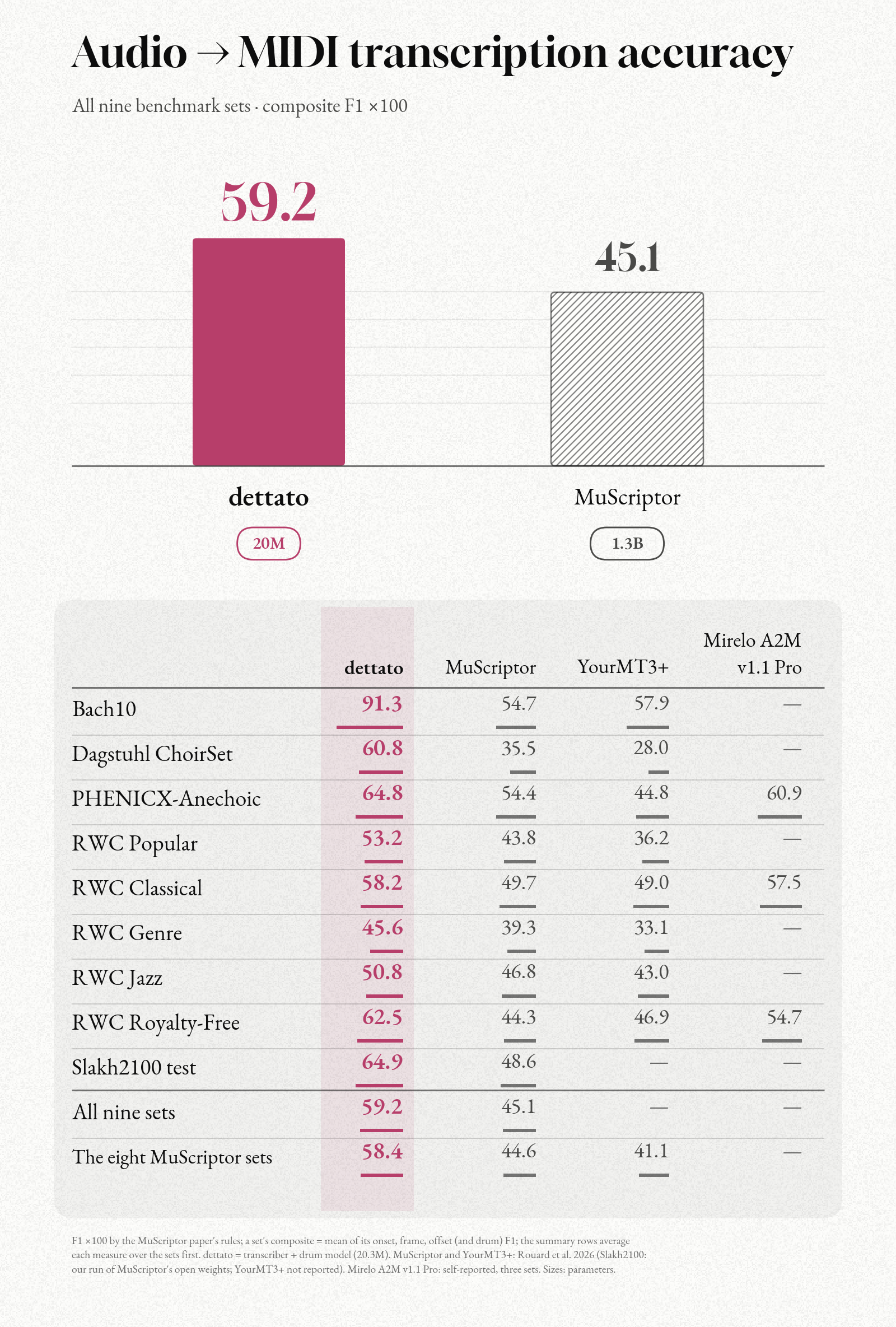
The benchmark is the eight sets from Table 2 of the MuScriptor paper, plus the Slakh2100 test set. The eight sets are Bach10, Dagstuhl ChoirSet, PHENICX-Anechoic, RWC Popular, RWC Classical, RWC Genre, RWC Jazz and RWC Royalty-Free. I scored them with the rules from that paper. The composite is the mean of the note onset, note frame, note offset and drum F1.
| system | parameters | composite | onset | frame | offset | drums |
|---|---|---|---|---|---|---|
| dettato transcriber + drums | 20.3M | 59.2 (95% 57.9-60.6) | 67.2 | 77.9 | 44.8 | 47.1 |
| MuScriptor | 1.3B | 45.1 | 48.6 | 70.2 | 27.8 | 34.0 |
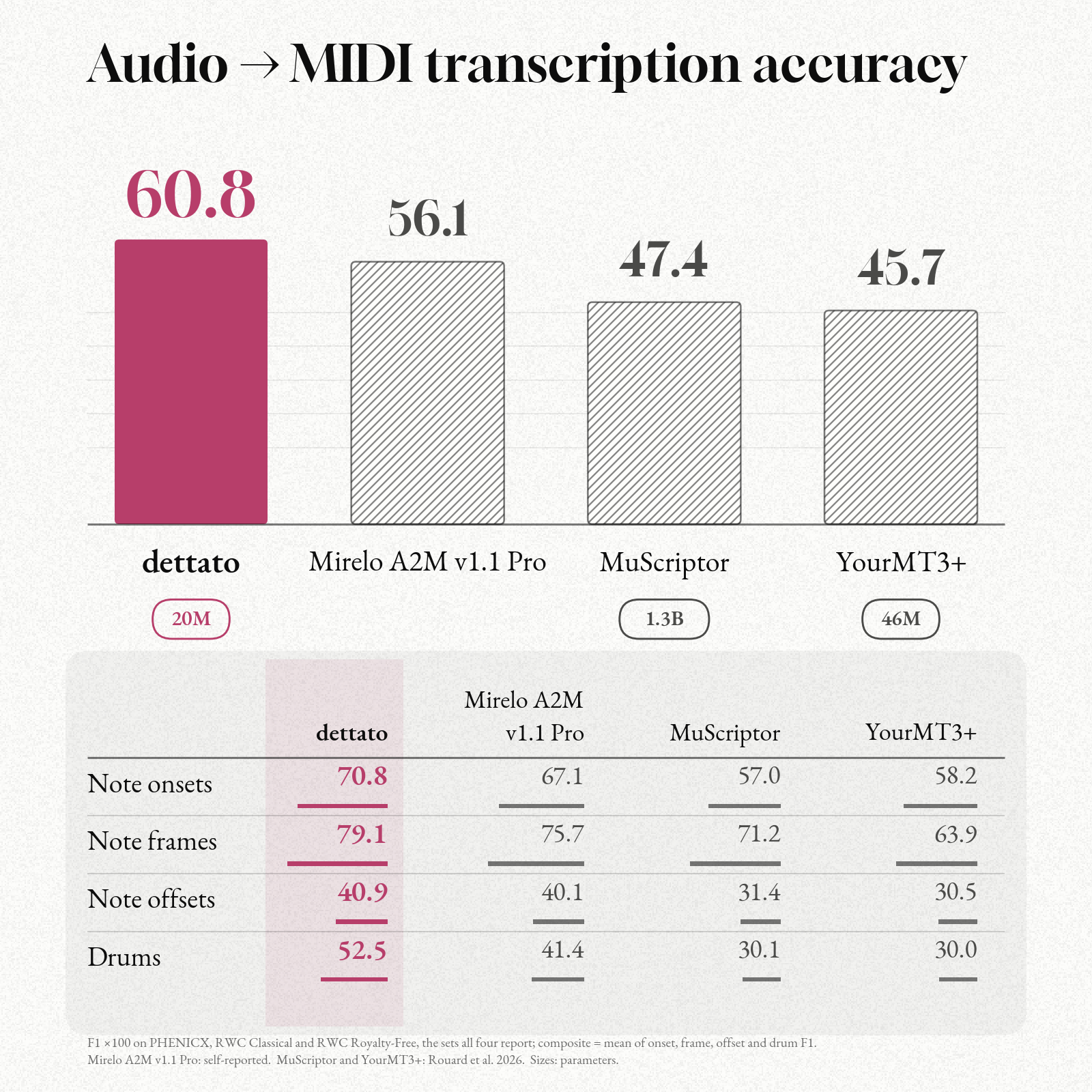
Mirelo A2M v1.1 Pro reports three of the sets: PHENICX-Anechoic, RWC Classical and RWC Royalty-Free. On those three, dettato scores 60.8. Mirelo A2M scores 56.1 (Mirelo published that number), MuScriptor scores 47.4 and YourMT3+ scores 45.7.
On the eight MuScriptor sets alone, dettato scores 58.4. MuScriptor scores 44.6 and YourMT3+ scores 41.1, which are the numbers from the paper. The tables for each set are on the dettato and dettato-drums cards.
The table scores the notes from the transcriber and the hits from the drum model. I measured the evidence repairer alone (+0.30 composite with the base network of the transcriber in front). The grouper was measured on my own track benchmark, and their cards have the details. I have not scored the four models as one chain yet, the way this package runs them.
Install
pip install git+https://github.com/kobimusic/dettato
dettato song.mp3 -o out/        # -> out/song.mid + out/song.json
The weights download from the Hugging Face Hub on first use (the dettato collection).
Models
Four models, 28.1M parameters in all, collected in the dettato collection. Each has its own model card:
| stage | model | parameters | what it does |
|---|---|---|---|
| 1 | kobimusic/dettato | 15.3M | notes from audio: onset, end and pitch on 88 keys, two voices per key |
| 2 | kobimusic/dettato-evidence | 4.9M | repairs the notes using the transcriber's own evidence: drops wrong notes, fixes onsets and ends, adds missed notes |
| 3 | kobimusic/dettato-grouper | 2.9M | puts every note in an instrument track and names the instrument |
| 4 | kobimusic/dettato-drums | 5.0M | drum hits on General MIDI drum keys, drum kits and orchestral percussion |
Use
Command line
dettato song.mp3 other.wav folder/ -o out/
- Takes any number of files and folders. Folders are searched recursively, and the folder structure is kept under
out/. - Writes
out/<name>.midandout/<name>.json(the tracks, note counts, the tuning estimate, which drum model ran). - Uses the GPU when there is one (
--device cputo force the CPU).
Python
import dettato

result = dettato.transcribe("song.mp3")       # loads the models once, then reuses them
result.save_midi("song.mid")
for track in result.tracks:
    print(track.name, track.program, track.is_drum, len(track.notes))   # notes: (N, 4) onset s, end s, pitch, velocity
For many files, load once and keep the object:
from dettato import Dettato

model = Dettato.from_pretrained("cuda")
for path in paths:
    model.transcribe(path).save_midi(path + ".mid")
Each stage can also be used on its own (dettato.transcriber, dettato.evidence, dettato.grouper, dettato.drums). The model
cards show how.
Weights offline
Set DETTATO_WEIGHTS to a folder holding the four model repos (dettato/, dettato-evidence/, dettato-grouper/,
dettato-drums/, each with its config.json and model.safetensors) to load them from disk instead of the Hub.
How it works
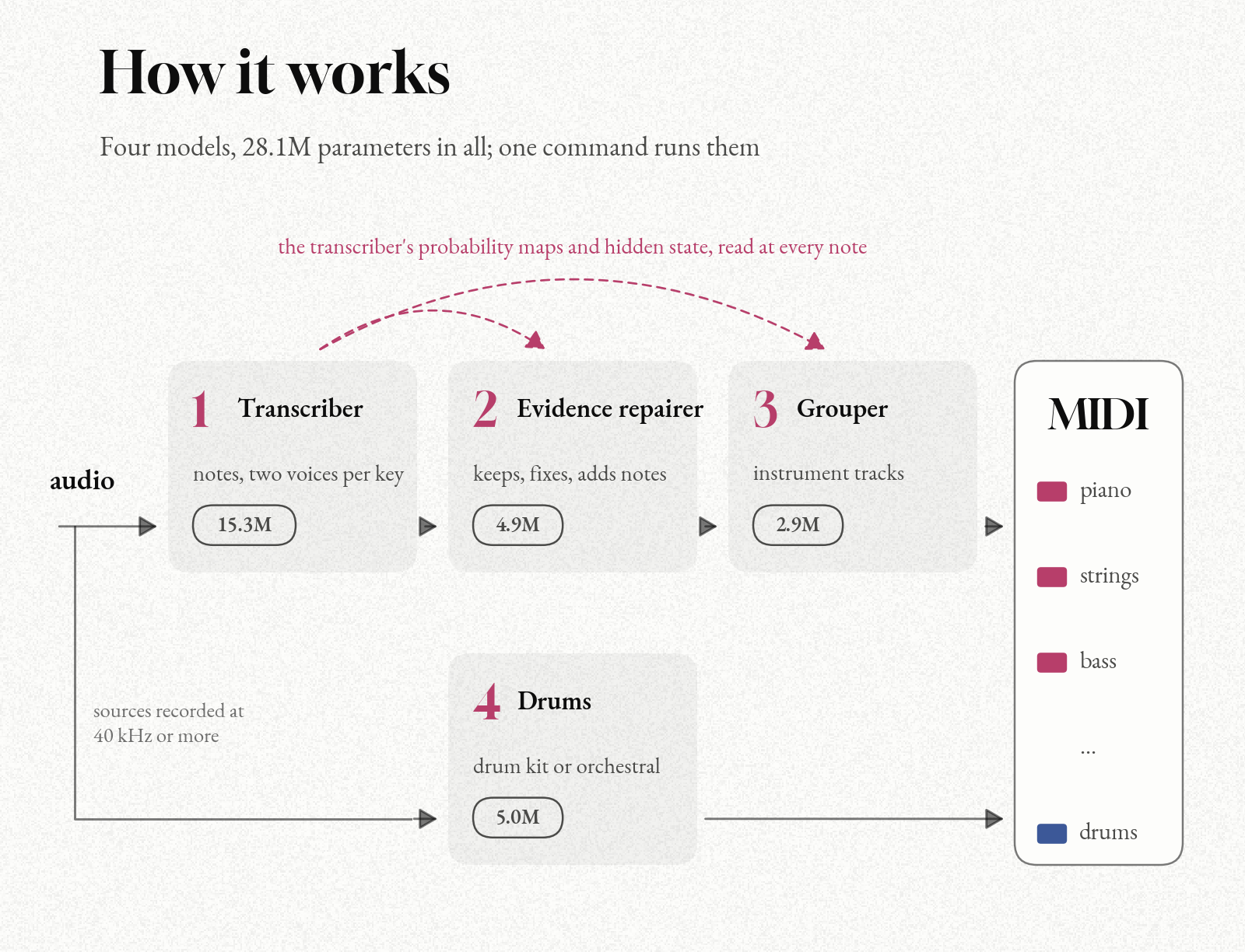
- Transcriber. A pitch-equivariant lane network reads a harmonic log-frequency spectrogram and gives onset, frame and offset probabilities for every key, for two voices per key, at 20 ms. The song is processed in overlapping 8 s windows (one every 2 s, averaged with a Hann taper), and notes come from peak picking. The network runs once per recording: that one pass feeds the repairer and the grouper (below). The recording's tuning is estimated first, and the pass runs on the retuned audio when it sits clearly off A440.
- Evidence repairer. A note-level transformer reads each note together with the transcriber's evidence for it (its probability maps around the note and its last hidden state) and decides which notes to keep, where they start and end, and which notes are missing.
- Grouper. The transcriber's internal features (the same pass, averaged over every other window) are gathered at every repaired note, and a note-level transformer gives each note an instrument and a track embedding. Notes are clustered into tracks. A track is kept only when it is clearly its own instrument, and tracks with the same instrument are merged.
- Drums. A small drum-kit model and an orchestral-percussion model. A router listens to the whole recording and picks one. The drum model needs audio recorded at 40 kHz or more and is skipped for lower-rate sources.
Requirements
- Python 3.10+, PyTorch 2.2+. A CUDA GPU is recommended: on an RTX 5060 (8 GB) a 4-minute song takes about 15 s and a 6-minute song about 25 s, and both peak under 4 GB of GPU memory (above 250 s the transcriber's feature buffers are kept in host memory, about 10 MB per second of audio, so GPU memory stops growing with the song's length). The CPU works but is slow (a 15 s clip took 87 s on a laptop CPU, model loading included).
- Audio is read with
soundfile. Formats it cannot read (m4a / aac, some mp3s) go throughffmpeg, which must then be on the PATH.
Limits
- Pitched notes cover the 88 piano keys, with at most two notes on the same key at once.
- Instrument names are only roughly right: on real jazz about a quarter of a saxophone's or lead guitar's notes can land in the piano's track, synth-heavy music is named less reliably, and a concert band gets rough names.
- No drums for sources recorded below 40 kHz.
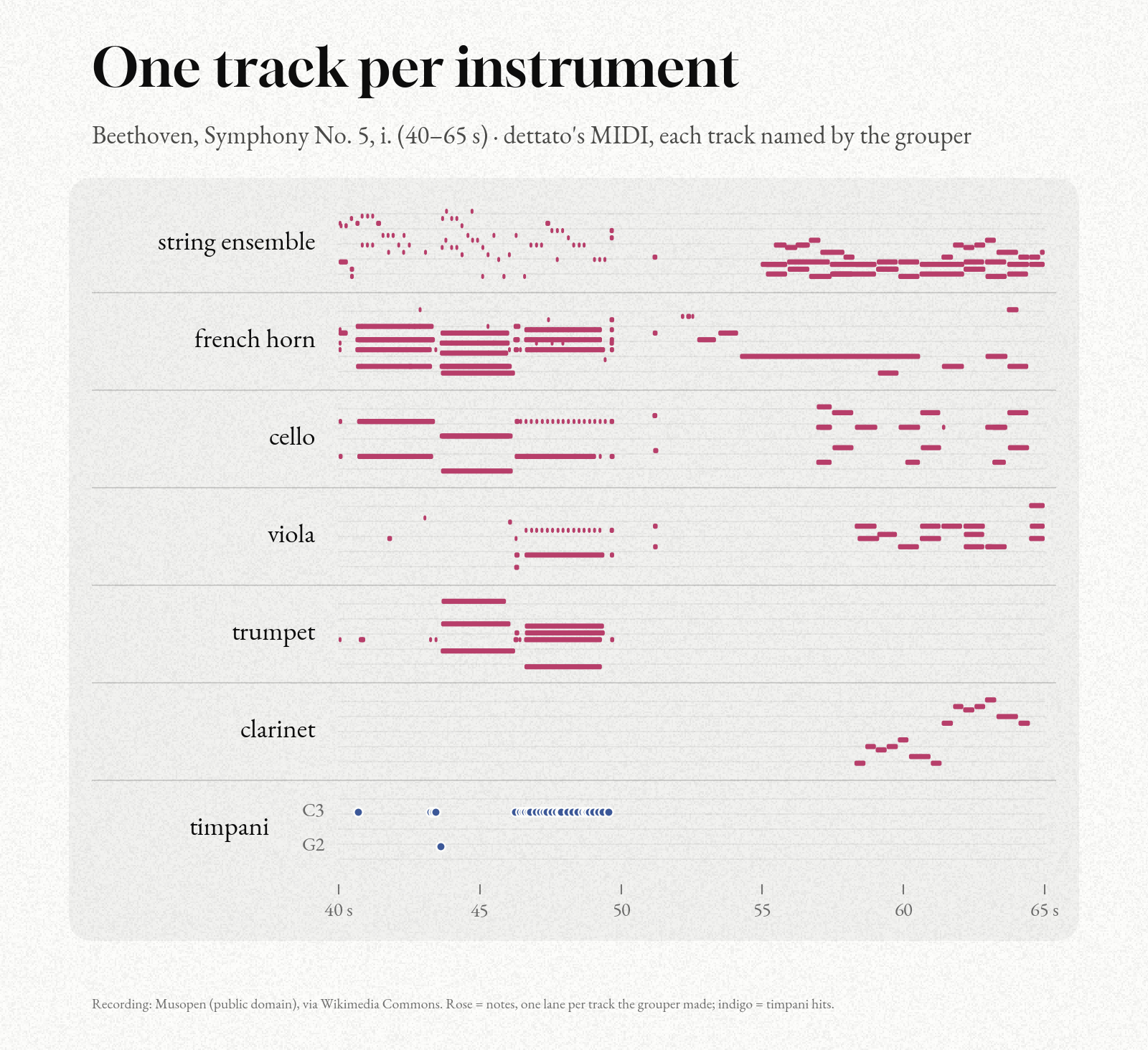
The example recordings in the figures are in the public domain: Beethoven's Symphony No. 5 and Grieg's Piano Concerto by Musopen (via Wikimedia Commons) and The Stars and Stripes Forever by the United States Marine Band.
Licence
Code and model weights: Apache-2.0 (see LICENSE and NOTICE). The model cards list the datasets each model was trained with and their licences. Some of the grouper's and the drum model's training datasets carry non-commercial terms.
Citation
@software{dettato2026,
  title  = {Dettato: multi-instrument audio-to-MIDI transcription},
  author = {Mills, Nathan},
  year   = {2026},
  url    = {https://github.com/kobimusic/dettato}
}
Dự án tương tự
Khám phá các dự án và mô hình AI khác có sự tương đồng.
MuScriptor — large (≈1.3B) MuScriptor is an open-weight model for general-purpose, multi-instrument automatic music transcription (AMT): it converts a music recording (any genre, multiple simultaneous instruments) into a stream of notes played. This...
MuScriptor — medium (≈300M) MuScriptor is an open-weight model for general-purpose, multi-instrument automatic music transcription (AMT): it converts a music recording (any genre, multiple simultaneous instruments) into a stream of notes played. Thi...
MuScriptor — small (≈100M) MuScriptor is an open-weight model for general-purpose, multi-instrument automatic music transcription (AMT): it converts a music recording (any genre, multiple simultaneous instruments) into a stream of notes played. This...
音乐转MIDI转换器 - Convert audio to multi-track MIDI with lyrics embedding
dettato dettato is the transcriber of KobiMusic's dettato, an audio to MIDI model. It takes any recording (a band, an orchestra, a piano or a voice) and finds the notes. For each note it gives the start, the end and the pitch on the 88 piano keys. I...
all-MiniLM-L6-v2 This is a sentence-transformers(https://www.SBERT.net) model: It maps sentences & paragraphs to a 384 dimensional dense vector space and can be used for tasks like clustering or semantic search. Usage (Sentence-Transformers) Using t...
Clone a voice in 5 seconds to generate arbitrary speech in real-time
🐸💬 - a deep learning toolkit for Text-to-Speech, battle-tested in research and production
🚀Clone a voice in 5 seconds to generate arbitrary speech in real-time